Nic salt shot, choosing one and getting the strength right
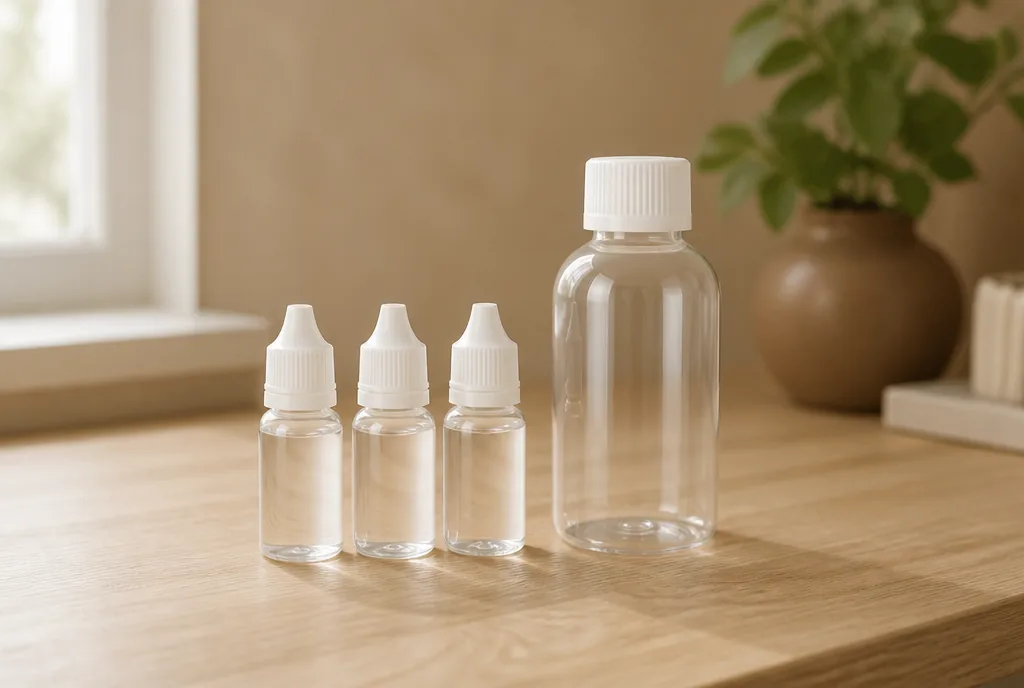
A 10 ml bottle with almost nothing on the label, and yet it decides the strength of everything it is poured into. A nic salt shot adds no flavour, but it sets the throat feel, the final concentration and even the ratio of the mix. Get the sums wrong and the result is a bottle that is too weak or too heavy, with the flavour taking the blame. How do you choose one and land on the right figure first time?
What a nic salt shot actually contains
A nic salt shot is a 10 ml bottle of unflavoured base, propylene glycol and vegetable glycerine, carrying nicotine in salt form, most commonly at 20 mg/ml. Its job is to add nicotine to a liquid that has none, usually a shortfill, a longfill or a home mix.
The format follows from UK rules, which cap refill containers of nicotine e-liquid at 10 ml and strength at 20 mg/ml, and limit tanks to 2 ml. Larger bottles are therefore sold nicotine-free and under-filled, leaving room for the shot.
Each 10 ml shot at 20 mg/ml holds 200 mg of nicotine. Every calculation that follows comes down to spreading those 200 mg across a larger or smaller final volume.
The word salt does not mean stronger. At 20 mg/ml, a salt shot carries exactly the same amount of nicotine as a freebase shot at the same figure, and only the throat feel differs.
Salt or freebase, the difference that matters in the mix
Nicotine salts pair the molecule with an organic acid, benzoic or salicylic depending on the maker, which lowers the pH compared with standard freebase nicotine. At an equivalent concentration, the throat feel is smoother. Our comparison of nic salts and freebase covers the chemistry and what it means for hardware.
For the arithmetic, the practical gap lies elsewhere. Salt shots are mostly sold at 20 mg/ml, while freebase shots are often 18 mg/ml, and that changes the divisor in every sum.
The final strength is calculated, not read off the label
The figure printed on the shot is never the strength of the finished liquid. It depends on how much nicotine goes in and on the total volume once mixed, which comes down to one formula and two checks.
The formula worth keeping to hand
The final strength equals the nicotine added divided by the final volume. To aim at a precise figure, turn that sum round.
Shot volume (ml) = target strength (mg/ml) × final volume (ml) ÷ shot strength (mg/ml)
The last term is 20 for a 20 mg/ml salt shot and 18 for an 18 mg/ml freebase shot, which is why the label matters.
The final volume includes the shot itself, a step that is easy to forget. For 100 ml at 6 mg/ml, the sum gives 6 × 100 ÷ 20 = 30 ml of shot, so three bottles, and only 70 ml of nicotine-free base. Pouring those three shots into 100 ml of liquid would give 130 ml at roughly 4.6 mg/ml.
Two shortfills worked through
A 50 ml shortfill sold in a 60 ml bottle takes one 10 ml shot. The bottle then holds 60 ml and 200 mg of nicotine, so 200 ÷ 60 gives about 3.3 mg/ml. With an 18 mg/ml freebase shot, the same bottle comes out at 180 ÷ 60 = 3 mg/ml exactly.
A 100 ml shortfill with 20 ml of headroom has space for two shots and no more. Two salt shots bring it to 120 ml and 400 mg, which is again about 3.3 mg/ml.
The shot’s PG/VG ratio ends up in the bottle
The 10 ml of base in a shot has its own PG/VG ratio, typically 50/50 or VG-heavy depending on the range, and that ratio blends with the liquid’s.
Take a 50 ml shortfill at 30/70 topped up with a 50/50 shot. Propylene glycol accounts for 15 ml from the liquid and 5 ml from the shot, so 20 ml out of 60, roughly 33/67 instead of 30/70. A 30/70 shot would have left the ratio untouched.
The sensible move is a shot in the same ratio as the liquid it joins, since throat hit follows the share of propylene glycol, as our note on the PG/VG ratio and nicotine explains.
Which nic salt shot suits which device
A shortfill topped up with one shot lands around 3 mg/ml, a strength aimed at direct to lung devices and sub-ohm tanks. On that hardware the abundant vapour already softens the throat feel, so picking a nic salt shot over a freebase one is mostly a preference for a smoother draw.
Mouth to lung devices and pods tend to run at higher figures than a single shot in a shortfill can reach. Those strengths come from ready-made 10 ml nic salt e-liquids or from a home mix with several shots, where the smoothness of salts keeps the concentration comfortable. Our note on nicotine strength and your device covers that pairing.
Moving up or down a step with a nic salt shot
A shot also lets you adjust a strength without changing liquid, when the current figure no longer suits the device. The method is to vary the volume those 200 mg are spread across.
Stepping down by adding volume
One shot in 100 ml of nicotine-free liquid gives 110 ml at 200 ÷ 110, about 1.8 mg/ml. Between that mix and the 3.3 mg/ml of a 50 ml shortfill, the same shot offers two distinct steps. Our note on reducing nicotine strength sets out the full method.
Stepping up without overfilling the bottle
Two salt shots in 50 ml of liquid give 70 ml at 400 ÷ 70, about 5.7 mg/ml. That mix needs a bottle of at least 70 ml, so it belongs in an empty bottle made for e-liquid rather than squeezed into a 60 ml shortfill.
Whichever the direction, change one variable at a time, otherwise there is no way to tell what altered the sensation.
Handling and storing shots with care
Nicotine is dangerous if swallowed and should not stay on the skin. Single-use nitrile gloves, a cap closed straight after pouring and a rinse with soap and water after any splash cover the basics. If a shot is swallowed, get medical help at once.
Keep shots in their original bottle with the child-resistant cap closed, out of reach of children and pets, and never decant them into a food or drink container. Label every home mix with its contents, strength and the date it was made.
FAQ
Five questions come up when a first shot is about to be poured, on points the arithmetic alone does not settle.
What is the difference between a nic salt shot and a nic salt e-liquid?
A shot is a usually unflavoured base designed to be mixed into another liquid. A nic salt e-liquid is a finished product, flavoured and already at its strength, ready for the tank. The first is an ingredient, the second is vaped as it comes.
Can a nic salt shot be vaped on its own?
No. It is designed as a mixing ingredient, and retailers state that it is not made to be vaped neat. Without flavour, it was built for the mixing bottle rather than the tank.
Can a freebase shot and a salt shot go into the same bottle?
Yes, as long as the sum is done on total nicotine. An 18 mg/ml freebase shot and a 20 mg/ml salt shot add 180 + 200 = 380 mg, so about 3.2 mg/ml in a 120 ml bottle. The mix keeps part of the hit that freebase brings.
Does the mix need to rest after adding the shot?
Above all it needs a firm shake with the cap screwed down, to spread the nicotine through the whole bottle. If bubbles form, a few minutes of rest is enough. Without shaking, the first fill can stray from the calculated strength.
How long does a nicotine shot keep?
The use-by date on the label is the reference. Storing the bottle closed, somewhere cool and away from light, helps keep it in condition until then.
Measuring a nic salt shot before pouring it
Three lines on the label are enough to choose a shot. Its form sets the throat feel, its 18 or 20 mg/ml changes the divisor in the sum, and its PG/VG ratio ends up in the finished bottle.
The rest is one division. Spread 200 mg of nicotine across the right volume, check the bottle can take it, and change one thing at a time. That is how a nic salt shot becomes a precise adjusting tool rather than a source of guesswork, and how every figure in this notebook keeps its meaning from one bottle to the next.
Editorial content for adult readers only. Nicotine is a highly addictive substance. Nicotine vaping products are not for sale to anyone under 18 in the UK. Nothing here is a purchasing recommendation or a recommended nicotine strength.
Armour G, choosing the coil and the nicotine strength
Armour G by Vaporesso, MTL or DTL pod, GTX coils from 0.15 to 1.2 ohm. The nicotine strength and PG/VG ratio that suit each coil, set out clearly.
Lire la note
PG/VG and nicotine: the ratio moves the throat hit
The PG/VG ratio changes how nicotine feels at an unchanged figure. How to read it, why a shortfill shifts it, and when the label is not the culprit.
Lire la note Practical factsheetsReducing nicotine strength one step at a time
How reducing nicotine strength works step by step: the arithmetic of dilution, the British shortfill route, and how to judge a step honestly.
Lire la note