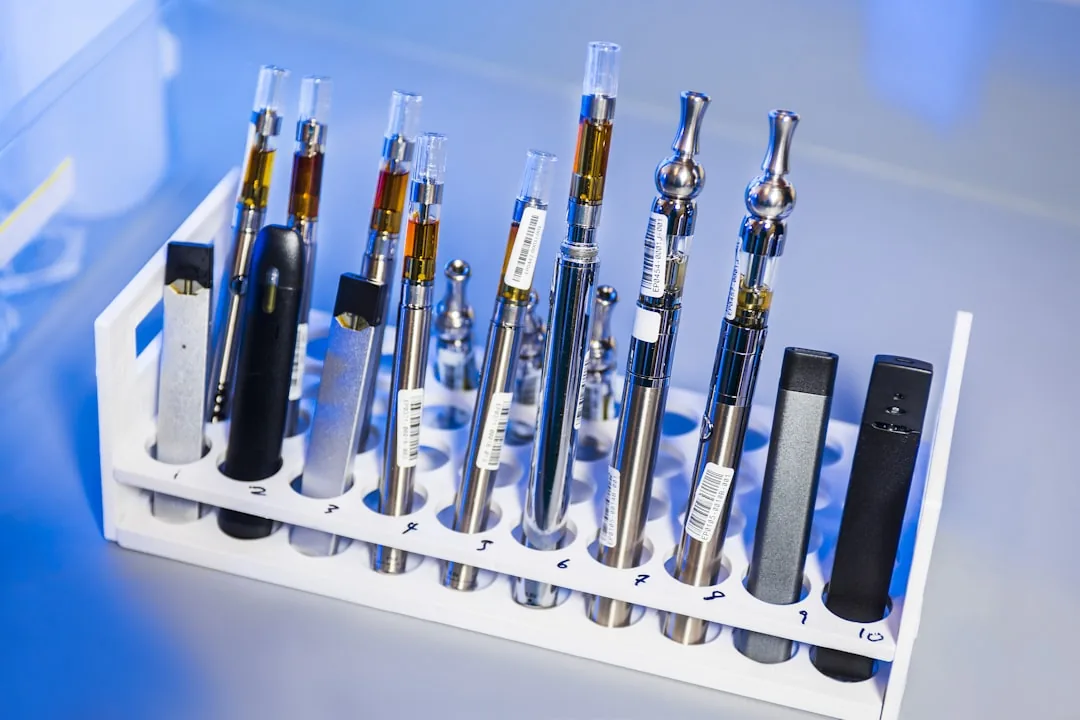
Nicotine strength and the device that carries it

The same bottle can feel entirely appropriate in a pocket pod and almost absent in a bigger tank. Nothing on the label has changed. The device has, and it is the device that decides how much of that liquid becomes vapour with every puff.
This is the variable that most guides to nicotine strength leave out, which is why so many of them contradict one another. A figure quoted without the hardware it belongs to is only half a statement, and the missing half is doing most of the work.
Where nicotine strength ends and the device begins
A bottle holds a concentration. A device turns some quantity of that liquid into vapour and delivers it in a particular way. Those are two separate stages, and only the first appears on any packaging.
Three properties of the hardware govern the second stage. How much power reaches the coil, which decides how much liquid is vaporised per second. How wide the airflow is, which decides how much air that vapour is diluted into. And how long a typical draw lasts, which the draw style effectively dictates.
Multiply those together and you have the quantity delivered per puff. A tight, low power device sits at the small end of all three, so it concentrates a modest amount of nicotine into a small, dense mouthful. An airy, high power device sits at the other end and spreads a much larger quantity of vapour across a much larger volume of air.
That is why a nicotine strength is never a property of the liquid alone. It is one term in a product, and the device supplies the rest.
Mouth to lung, restricted, direct to lung
British shops sort hardware by draw style before anything else, and the vocabulary is worth having straight because it predicts everything downstream.
Mouth to lung, usually abbreviated MTL, draws through a narrow airway. Vapour is held briefly in the mouth before being inhaled, output is small, and the sensation is concentrated. Compact pods and pen-style kits are almost all built this way.
Direct to lung, DTL, draws a wide column of air straight down. Output is large, the vapour is diluted into a great deal of air, and the throat sensation is correspondingly softer at an identical concentration.
Restricted direct to lung, RDL, sits between the two, with a wider airway than MTL but nothing like the volume of a full DTL setup. It is the fastest growing category in British retail and the one where general advice is least reliable, precisely because it straddles the two established ends.
Reading coil resistance and power
There is a figure printed on the hardware itself that places a device on this scale without any guesswork, and it is the one people overlook.
Coil resistance is stated in ohms, on the coil and usually in the manual. Above roughly one ohm, a coil runs at modest power, produces little vapour and belongs to the tight draw end. Below one ohm, described as sub-ohm, power rises sharply and vapour output rises with it.
That threshold around one ohm is the single most useful marker available, because it correlates with everything else: airflow, wattage, tank size and the form of nicotine the device is designed around.
Wattage confirms it. A device operating in the low single figures and one operating well into the tens are not doing the same job, and the same nicotine strength passing through them will not arrive in the same quantity.
What each device family implies for nicotine strength
The table below describes what British shops actually stock alongside each kind of hardware and which way the concentration scale runs. It records how the market is organised. It is not a recommendation, and no figure below should be read as a suggested dose.
| Device family | Draw | Coil resistance | Vapour volume | Direction on the scale |
|---|---|---|---|---|
| Compact pod, prefilled or refillable | Tight, MTL | Well above 1 ohm | Low | Upper part of the scale, usually salts |
| Pen or small refillable tank | Tight to restricted | Around or above 1 ohm | Low to moderate | Middle of the scale |
| Restricted direct to lung tank | Restricted, RDL | Around or below 1 ohm | Moderate | Lower middle of the scale |
| Sub-ohm tank at higher power | Airy, DTL | Well below 1 ohm | High | Bottom of the scale |
Two things follow from the shape of that table. The upper part of the British scale exists almost entirely to serve devices that produce very little vapour, which is also why it is dominated by the salt form, as our comparison of nic salts and freebase sets out.
And the bottom of the scale is not a lesser version of the top. On a high output device it can deliver more per puff than a much larger figure does in a pod, which is the calculation the label cannot do for you.
The 2 ml cap and what it hides
British rules cap tanks and pods at 2 ml, cap bottles containing nicotine at 10 ml, cap nicotine-containing e-liquid at 20 mg/ml and restrict sales to adults of 18 and over. The tank cap is the one that interacts with hardware most directly.
Because every tank on the market holds the same 2 ml, refill frequency becomes a rough proxy for consumption. A sub-ohm device emptying its tank several times a day and a pod emptying it once are consuming quantities that differ by an order of magnitude, at whatever concentration is in them.
That is a more honest measure than the label. Anyone trying to understand their own position is better served by counting refills across an ordinary week than by comparing figures printed on bottles.
It also explains why a change of device disturbs everything. New hardware means a new consumption rate, and our note on reducing nicotine strength covers why the two should never be changed on the same day.
The base of the liquid, the last term
One more variable sits between the bottle and the device, and hardware constrains it more than most people realise.
Thin liquids rich in propylene glycol wick easily through narrow coils and sharpen both flavour and throat sensation. Thick liquids rich in vegetable glycerine produce dense vapour and need the wider wicking channels that sub-ohm coils provide.
The practical consequence is that hardware effectively selects the base. Put a thick liquid in a tight coil and it starves, put a thin one in a wide coil and it leaks, so the choice is rarely free.
Since the base also moves the throat sensation at an unchanged concentration, changing device usually changes two things at once, a compounding effect our note on the PG/VG ratio and nicotine unpicks in full.
Frequently asked questions
Why does the same bottle feel stronger in a small pod?
Because a tight pod produces very little vapour and concentrates whatever nicotine it carries into a small mouthful. The same liquid in an airy device spreads that nicotine through a far greater volume of vapour and air, which softens the sensation without changing the label.
How do I tell whether my device is sub-ohm?
Read the resistance printed on the coil. Below one ohm is sub-ohm, associated with higher power, wider airflow and large vapour output. Above one ohm, the device runs at modest power with a tighter draw and much lower output.
Should the figure change when the device changes?
Usually something has to, because the new hardware consumes a different quantity of liquid per puff. The reliable method is to change the device first, use it for a few ordinary days at the existing figure, and only then decide whether the concentration needs revisiting.
Does the base ratio affect what the device needs?
Yes, and hardware largely dictates it. Narrow high resistance coils need thinner liquids to wick properly, while sub-ohm coils are built for thicker ones. Using the wrong base produces starving or leaking rather than a nicotine problem, though it is often mistaken for one.
Is a refill count more useful than the label?
For understanding consumption, yes. Since every British tank holds the same 2 ml, counting how often it is refilled across an ordinary week measures the quantity actually going through the device, which the concentration on the bottle cannot tell you on its own.
Reading the pair, not the bottle
A nicotine strength printed on a label is an input. What reaches you is that input multiplied by everything the device does with it: the power at the coil, the width of the airflow and the length of the draw. Ignore the second half and the first half stops meaning anything.
The practical version is short. Find the resistance on your coil, place the device on the tight to airy scale, note the base the hardware requires, and read the bottle in that context rather than on its own.
Do that and the contradictions between the guides stop mattering, because you can see what each of them silently assumed about the hardware. Reading the nicotine strength together with the device that carries it, note after note, is the habit this notebook is built around.
Editorial content for adult readers only. Nicotine is a highly addictive substance. Not for sale to anyone under 18 in the United Kingdom. Nothing here is a purchasing recommendation or a recommended nicotine strength.
E-liquid flavours for beginners: strength decides
A flavour cannot be judged apart from the figure it is vaped at. Which e-liquid flavours hold up high on the scale and which need the lower part of it.
Lire la note
Nicotine in a cigarette and the e-liquid comparison
How much nicotine in a cigarette, what is actually absorbed, and why the popular UK equivalence with mg/ml compares two units that do not meet.
Lire la note
Nicotine strength: reading the number on the bottle
What nicotine strength measures, how the UK scale is built, and the reasoning that lets you place a bottle without trusting a recommendation chart.
Lire la note