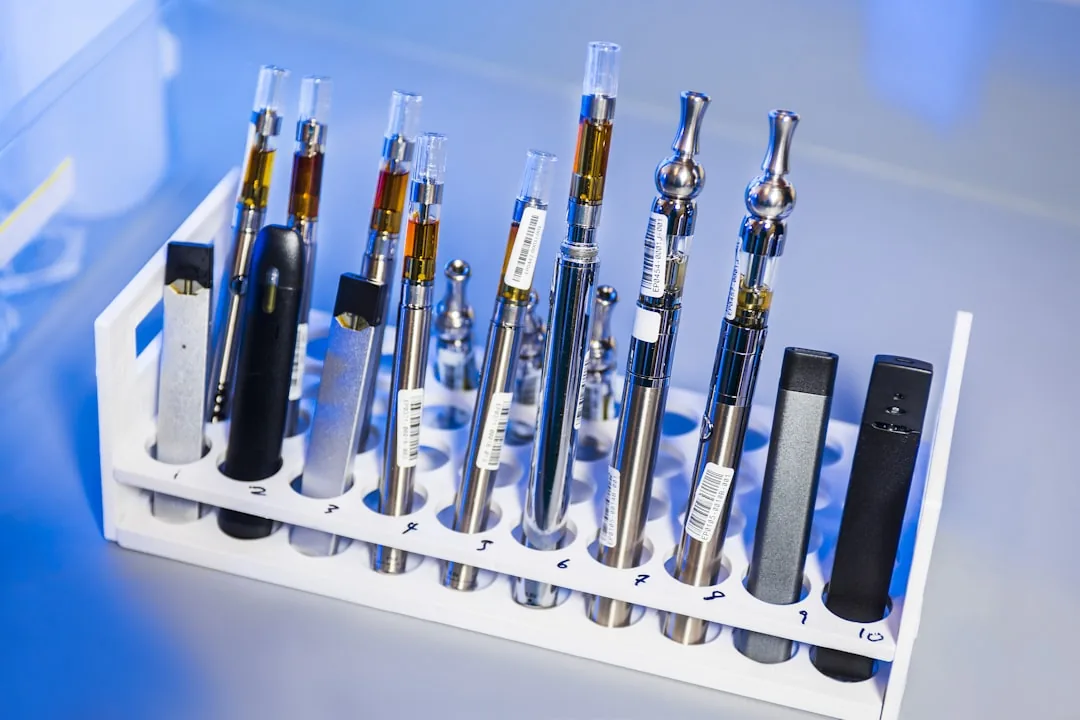
Nicotine in a cigarette and the e-liquid comparison

How much nicotine in a cigarette, and what does that come to in e-liquid? It is one of the most searched questions in British vaping, and the answers on the first page of results confidently contradict each other. One says a 10 ml bottle equals a fortnight of smoking, another puts a single 2 ml device at twenty cigarettes, a third gives a neat chart.
They cannot all be right, and the reason they differ is not that the data is scarce. It is that the two figures being compared are not measurements of the same kind of thing. This note sets out where the confusion starts and what the comparison can honestly be used for.
The nicotine in a cigarette is not the nicotine absorbed
Two entirely different quantities travel under the same word, and almost every equivalence chart quietly swaps one for the other.
The first is content: how much nicotine the tobacco in one cigarette holds. Specialist sources place this in the region of eight to twenty milligrams depending on the product, with British brands commonly cited towards the lower end of that range.
The second is delivery: how much of it actually reaches the person smoking. That figure is far smaller, generally put at somewhere around one to two milligrams per cigarette, because combustion destroys part of the nicotine and a further part leaves in smoke that is never drawn in.
A chart that takes the content figure and lines it up against a bottle of e-liquid is therefore building on a quantity nobody actually receives. That is how two guides can differ by a factor of ten and both sound authoritative.
Two units that do not meet
Set the delivery problem aside and there is still a measurement problem underneath it.
A cigarette is counted as an object, and its nicotine is expressed as milligrams per object. An e-liquid is a volume, and its nicotine is expressed as milligrams per millilitre. One is a total, the other is a density.
Putting an equals sign between them requires a third figure that nobody prints: how many millilitres a given person turns into vapour in a day. Without that, the two sides of the equation have no common term at all, and the nicotine in a cigarette simply cannot be converted into a concentration on a label.
This is why the ubiquitous claim that a 20 mg/ml liquid corresponds to a certain number of cigarettes tells you nothing on its own. It is a sentence with a missing variable, filled in silently by whoever wrote it.
Where the popular UK equivalence comes from
The figure most often repeated in British guides is arrived at by assuming a millilitre a day, then multiplying. Twenty milligrams per millilitre, one millilitre consumed, twenty milligrams in total, and a cigarette absorbed at roughly one milligram gives twenty cigarettes.
Every step of that is a modelling choice. The daily volume is an assumption, the absorbed figure is an average, and neither accounts for how much of the vaporised nicotine is actually taken up rather than exhaled.
The number is not fabricated, but it is a scenario rather than a conversion rate. Change the assumed daily volume, which varies enormously between a tight low power device and an airy high power one, and the whole result moves with it.
That variation is not a detail. It is the largest term in the calculation, and it is the one no chart can know about you.
What vaping adds to the equation: time
There is a structural difference the arithmetic tends to hide. A cigarette is a discrete event with a beginning and an end, consumed in minutes, and the quantity it delivers is bounded by the object itself.
A tank has no such boundary. Liquid is drawn on across a whole day, in bursts of a few puffs, and nothing about the device signals that a unit has been completed. The quantity consumed is a function of habit rather than of the product.
That is why the same bottle can last one person a fortnight and another four days at an identical concentration. The label is a constant; the behaviour around it is not, and it is the behaviour that decides the total.
Any honest comparison has to be framed in terms of habits over days, not as a fixed exchange rate printed on a chart.
Why the 20 mg/ml ceiling does not settle the question
British rules cap nicotine-containing e-liquid at 20 mg/ml, cap bottles containing nicotine at 10 ml, cap tanks and pods at 2 ml and restrict sales to adults of 18 and over. Those are facts about what may be sold, and they are frequently pressed into service as though they were facts about dosage.
They are not. A ceiling on concentration says nothing about how many millilitres pass through a device, which is the term that actually governs the total. Two people on the same capped concentration can be far apart on that term, and the label cannot tell them apart.
What the ceiling does usefully do is bound the top of the retail scale, which is why no ready-filled British product goes above it. Understanding how that scale is built is the subject of our note on reading nicotine strength on the bottle.
What the nicotine in a cigarette can still tell you
If the conversion does not exist, the question is what remains. Two things do, and they are more useful than a chart.
The first is scale awareness. Knowing that a cigarette delivers on the order of a milligram or two, rather than the eight to twenty it contains, corrects the instinct to reach for the top of the concentration scale on the assumption that anything less is negligible.
The second is variable isolation. Since the total depends on concentration, on device and on frequency, the way to understand your own position is to hold two of those constant and observe the third. Our note on nicotine strength and your device covers the device term, and the form of nicotine involved is set out in our comparison of nic salts and freebase.
Neither of those produces a number to quote at a shop counter. Both produce something a chart cannot: a reading that stays true when the kit changes.
Frequently asked questions
How much nicotine does a cigarette contain?
Specialist sources place the content of a single cigarette in the region of eight to twenty milligrams, with British brands often cited towards the lower part of that band. That is what the tobacco holds, not what the smoker receives, and the two figures are routinely confused.
How much is actually absorbed from one cigarette?
Considerably less than the content. Published figures generally sit around one to two milligrams, because combustion destroys some of the nicotine and more of it leaves in smoke that is never inhaled. This is the figure that matters in any comparison.
Does 20 mg/ml equal a pack of cigarettes?
Only under an assumed daily volume that is stated nowhere on the packet. The claim multiplies a concentration by a millilitre figure someone has chosen on your behalf, and that figure varies enormously between devices, which makes the result a scenario rather than an equivalence.
How many cigarettes does a 10 ml bottle correspond to?
There is no fixed answer, because a 10 ml bottle is a volume and a cigarette is an object. How long that bottle lasts depends on the concentration, the power of the device and how often it is used, and two people at the same concentration can differ by weeks.
Is the comparison useless then?
Not useless, but it is a sense of scale rather than a conversion. It corrects the assumption that cigarettes deliver enormous quantities, and it makes clear that the total received from a device is governed by how much liquid is consumed, which is the term charts leave out.
Reading the two figures at their own scale
The nicotine in a cigarette is a quantity per object, most of which is never received. The figure on an e-liquid bottle is a density per millilitre, and what it delivers depends entirely on how many millilitres are consumed. Those are different measurements, and no chart can bridge them without inventing the term that connects them.
That is the whole of the confusion, and seeing it dissolves a lot of anxiety about picking the wrong number. There is no exchange rate to get wrong, only a set of variables to observe one at a time.
Take the content figure for what it is, take the absorbed figure for what it is, and treat any equivalence you are handed as a scenario built on assumptions you are entitled to check.
Read that way, the nicotine in a cigarette stops being a number to convert and becomes what it always was: a sense of scale, useful for keeping expectations honest and useless as an instruction. Reading each figure at its own scale, page after page, is what this notebook is for.
Editorial content for adult readers only. Nicotine is a highly addictive substance. Not for sale to anyone under 18 in the United Kingdom. Nothing here is a purchasing recommendation or a recommended nicotine strength.
E-liquid flavours for beginners: strength decides
A flavour cannot be judged apart from the figure it is vaped at. Which e-liquid flavours hold up high on the scale and which need the lower part of it.
Lire la note
Nicotine strength and the device that carries it
The same nicotine strength behaves differently in a pod and a sub-ohm tank. How draw, coil resistance and power decide what a label delivers.
Lire la note
Nicotine strength: reading the number on the bottle
What nicotine strength measures, how the UK scale is built, and the reasoning that lets you place a bottle without trusting a recommendation chart.
Lire la note