Nicotine strength: reading the number on the bottle
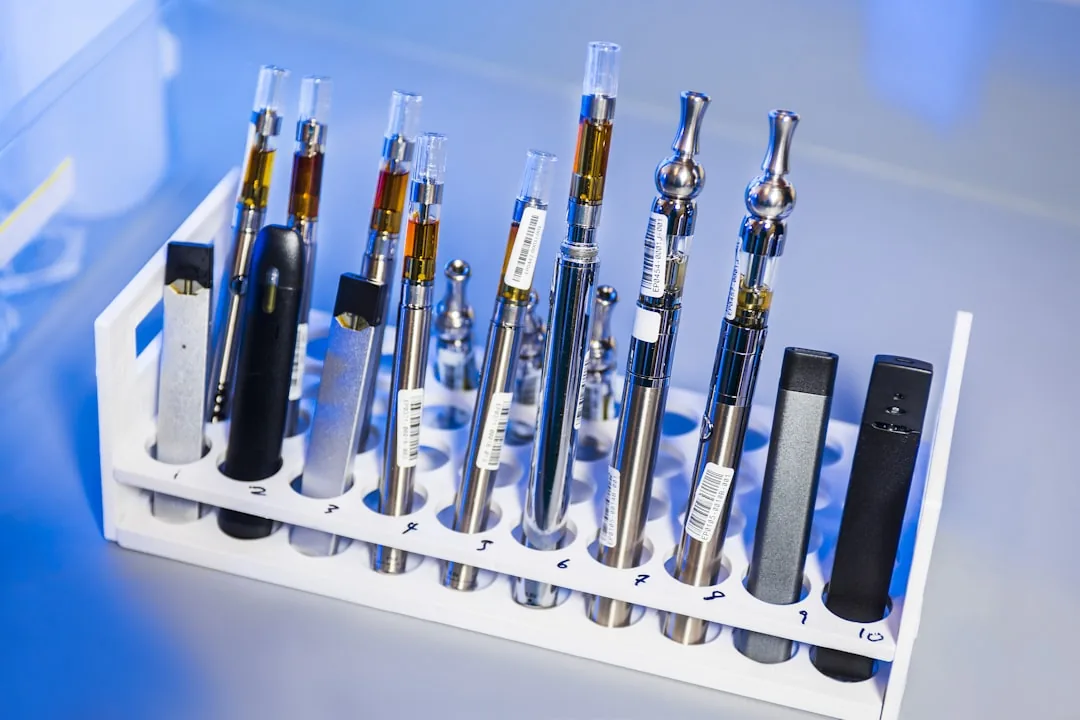
Walk into any British vape shop and one figure repeats itself on every shelf: 3, 6, 10, 12, 18, 20. That number is the nicotine strength, and almost every guide online answers it the same way, with a chart that matches a number of cigarettes to a number of milligrams. Those charts are confident, they contradict each other, and none of them explains how the figure was arrived at.
This notebook takes the opposite approach. Rather than hand you a value, it sets out what the number describes, what it does not describe, and how to read a bottle so the decision is yours rather than a shop’s.
What nicotine strength actually measures
Nicotine strength is a concentration, expressed in milligrams of nicotine per millilitre of liquid. A bottle labelled 12 mg/ml holds twelve milligrams of nicotine in every millilitre it contains, no more and no less.
That is the entire definition, and it is narrower than it looks. The figure describes the liquid sitting in the bottle. It says nothing about how much nicotine reaches you, because that depends on how much liquid you turn into vapour and how you inhale it.
British labels use two notations for the same thing. A percentage figure is the same measurement moved by a decimal point: 2% is 20 mg/ml, 1% is 10 mg/ml, 0.3% is 3 mg/ml. Shops mix the two freely, sometimes on the same shelf, which is worth knowing before comparing two bottles that look unrelated.
Every nicotine-containing e-liquid sold legally in Britain must carry this concentration on the label. A bottle with no nicotine figure on it is, in principle, a zero nicotine liquid.
The ceiling the UK scale is built against
British rules set the top of the scale rather than a point on it. Nicotine-containing e-liquid cannot exceed 20 mg/ml, bottles containing nicotine are capped at 10 ml, and tanks or pods are capped at 2 ml. Sales are restricted to adults aged 18 and over.
That 20 mg/ml ceiling is a legal fact and nothing more. It is not a target, not a starting point and not a figure anyone recommends. It simply explains why no ready-filled British product goes higher, and why the whole retail scale compresses into the range below it.
Knowing where the ceiling sits does help with one thing: it tells you how much room a given bottle leaves in either direction. A liquid sitting at the top of the scale has nowhere further to go, which matters when the question is what to change next.
Why a recommended nicotine strength is the wrong output
The charts that dominate British search results share a structure. They take a former smoking habit, convert it into a nicotine strength, and present the result as advice. The conversion is the problem, and a separate note on nicotine in a cigarette compared with e-liquid sets out exactly why those two figures do not share a unit.
There is a second problem, less obvious. Those charts treat the strength as an output, when it is really an input to a system with three other variables: the device, the liquid base, and how often the device is picked up. Fix one variable and the others move.
So the useful output is not a number but a method. Read what the bottle says, note what device it will be used in, note what the base is, then change one of those three things at a time and observe what happens over several days rather than several puffs.
That is slower than a chart and it is the only approach that survives a change of kit.
Why the same nicotine strength feels different in two devices
The most common source of confusion is a bottle that seemed correct in one device and seems wrong in another, with no change to the label at all.
The mechanism is simple. A tight mouth to lung device produces a small quantity of vapour per puff, so the nicotine it carries arrives concentrated. A direct to lung device producing a large cloud spreads the same concentration across far more vapour, and the sensation flattens accordingly.
Neither device changed what is in the bottle. They changed how much of it is consumed per puff, which is the figure nobody prints. Our note on nicotine strength and your device works through that pairing in detail.
The base of the liquid adds a third layer, because the ratio of propylene glycol to vegetable glycerine alters the throat sensation at an unchanged concentration.
Shortfills: the British case where you build the figure yourself
Britain has a market structure that most guides ignore, and it changes the whole conversation. Because bottles containing nicotine are capped at 10 ml, larger bottles are sold nicotine-free and under-filled, then topped up with a small nicotine shot.
The consequence is that the final concentration is not printed on anything. It is the result of an arithmetic you perform: total nicotine added, divided by total volume in the bottle.
A single 10 ml shot at 18 mg/ml added to a 50 ml nicotine-free liquid gives 60 ml in total, and 180 milligrams spread across 60 millilitres works out at 3 mg/ml. Change either number and the answer moves, which is why shortfill users tend to understand the measurement better than anyone else.
Two practical points follow. Shots come in different bases, so a shot can shift the ratio of the liquid it goes into. And a home-mixed bottle needs shaking properly, because an unmixed shot sits where it was poured.
The readings that distort the number
A handful of habits make it impossible to judge a bottle honestly, and they recur constantly.
- Changing the liquid and the device on the same day, which leaves two candidate explanations and no way to separate them.
- Judging a bottle on a single session rather than across several days of ordinary use.
- Comparing two liquids from different ranges, where the flavour concentrates differ as much as the concentration does.
- Reading a percentage as though it were a milligram figure, or the reverse.
Isolating a single variable is unglamorous and it is the only method that produces a reliable reading. Where a change of concentration is genuinely the answer, our note on reducing nicotine strength covers how that is done without whiplash.
Frequently asked questions
Does every UK e-liquid have to show its nicotine strength?
Yes. Any nicotine-containing e-liquid sold legally in Britain must display its concentration on the label, in mg/ml or as an equivalent percentage. A bottle carrying no nicotine figure is, in principle, a zero nicotine liquid.
What is the difference between 2% and 20 mg/ml?
Nothing. They are two notations for one measurement, and 2% is 20 mg/ml, which is also the British legal maximum for nicotine-containing e-liquid. Shops use whichever notation suits their labelling, sometimes both.
Can two bottles be mixed to land between two figures?
They can, provided both come from the same range and share the same base ratio. Equal parts of a 12 mg/ml and a zero nicotine liquid give roughly 6 mg/ml. Combining different ranges changes the flavour as well as the concentration.
Does a higher figure mean the bottle empties faster?
Not mechanically. How quickly a bottle empties depends on the power of the device and how often it is used, not on what is dissolved in the liquid. Two people on the same bottle can finish it weeks apart.
Is there a universal starting figure for a new vaper?
No, and the guides that offer one are compressing several variables into a single number. The scale runs from zero to the 20 mg/ml legal ceiling, and where a given person sits on it is a matter of observation across days, not a value that can be looked up.
Reading the figure, rather than being handed one
A nicotine strength is a concentration in a bottle, and everything else about the experience is decided by the device that vaporises it, the base that carries it and the frequency it is used at. That is why no chart can be right for long: it fixes one variable and pretends the other three do not exist.
The habit worth building is unremarkable. Read the label properly, know which notation it uses, know that the British scale is capped at 20 mg/ml, and change one thing at a time when something feels off.
Do that and the number stops being a decision made for you at the till. It becomes a reading you take yourself, bottle after bottle, which is the whole ambition of this notebook.
Editorial content for adult readers only. Nicotine is a highly addictive substance. Not for sale to anyone under 18 in the United Kingdom. Nothing here is a purchasing recommendation or a recommended nicotine strength.
E-liquid flavours for beginners: strength decides
A flavour cannot be judged apart from the figure it is vaped at. Which e-liquid flavours hold up high on the scale and which need the lower part of it.
Lire la note
Nicotine in a cigarette and the e-liquid comparison
How much nicotine in a cigarette, what is actually absorbed, and why the popular UK equivalence with mg/ml compares two units that do not meet.
Lire la note
Nicotine strength and the device that carries it
The same nicotine strength behaves differently in a pod and a sub-ohm tank. How draw, coil resistance and power decide what a label delivers.
Lire la note